Read summarized version with
‘If you cannot measure it, you cannot improve it.’ - Lord Kelvin.
You poured your heart, soul, and cash into marketing, only to watch potential customers slip through your fingers like sand. Frustrating, right? Every business owner, marketer, and entrepreneur has been there, struggling to turn website visitors into paying customers.
The medicine to your woes is conversion rate optimization. CRO is how you transform window shoppers into loyal customers without breaking the bank. It reveals exactly how to squeeze maximum value from every single visitor that lands on your site.
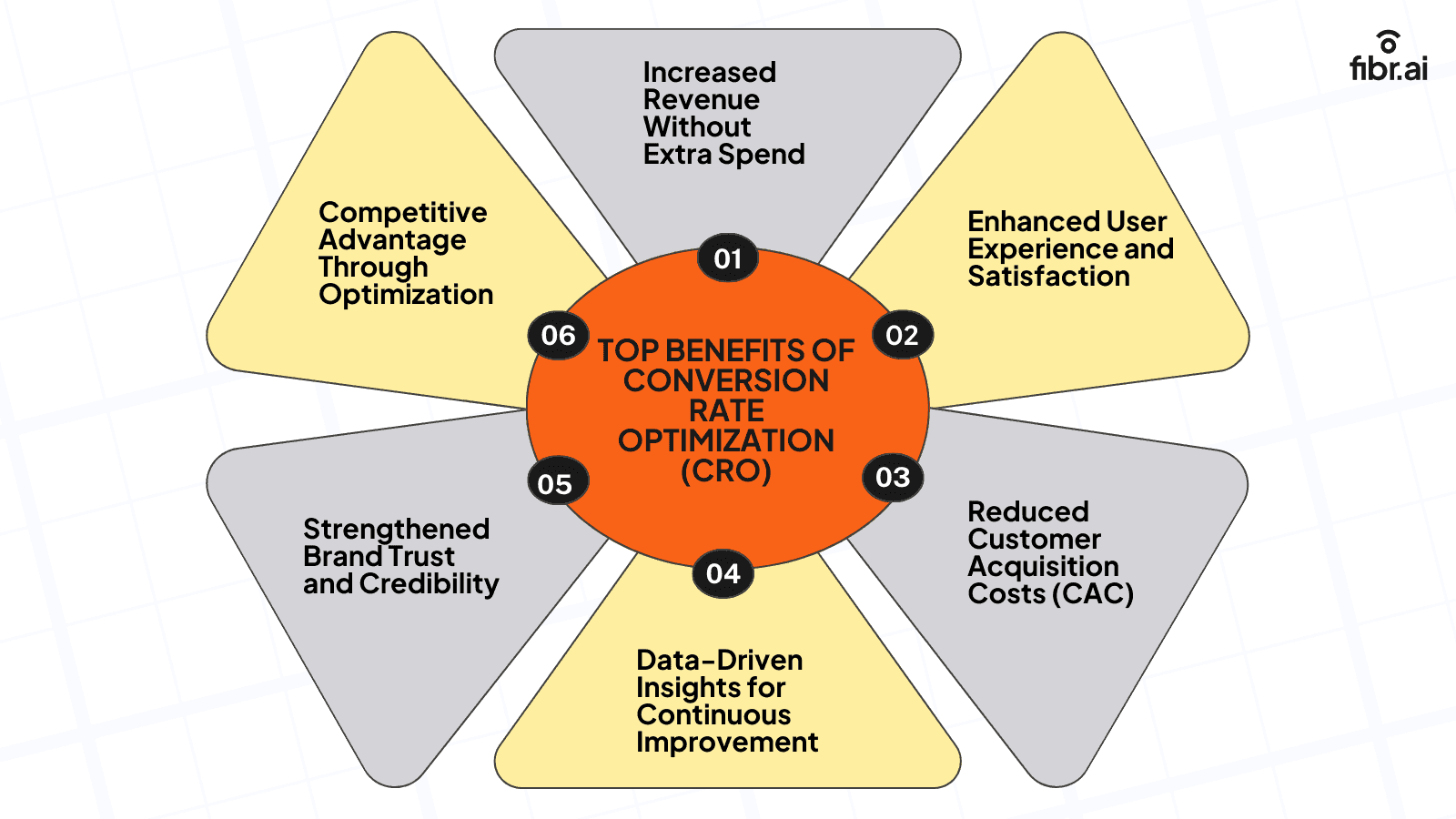
In this guide, we're discussing the six benefits of conversion rate optimization. Let’s learn how CRO can be the difference between marketing that merely looks good and marketing that actually makes you money.

What is conversion rate optimization?
Conversion rate optimization is a systematic approach to push your visitors to take action–whether buying a product or signing up with a newsletter and more. Typically, conversion rates are calculated as below:
Conversion rate=No. of visitors who take action / Total visitors*100
So, if you have 100 visitors who take action and 5000 total visitors, your conversion rate would be 2% (200/5000*100).

Conversion rates across industries typically range from 1-5%, with top performers achieving up to 10%. However, these rates aren't universal benchmarks but contextual indicators.
The real goal isn't comparing yourself to industry averages but consistently improving your own conversion performance. Conversion rates fluctuate based on factors like:
Industry type
Geographic location
Economic conditions
Traffic source
Device type
You need to understand these variables for meaningful optimization. Now, let's explore the core benefits of conversion rate optimization.
Now, without much ado, let’s understand in detail the benefits of conversion rate optimization.
Top benefits of CRO
As we’ve already established, CRO maximizes your marketing effectiveness by extracting more value from existing traffic and campaigns. Here's how CRO benefits your digital performance:
1. Increased revenue with improved conversion rates
You must probably be wondering: ‘Another article about increasing revenue’; but stay with us. This isn’t your typical word salad that ultimately adds no value. At Fibr AI, when we speak about the top CRO benefits, we speak about revenue. We talk about making money from the visitors you already have.
Let’s get real. Most businesses, big and small, spend a lot of money on PPC, and other complicated SEO strategies. Some do manage to build and drive traffic. Yet, their CRO ranges between 1-2% or lower. Now, think for a second from a business perspective: is the effort worth the time and money invested? Did the business add revenue and new clients?
You already know the answer. And, it’s likely negative because the user cannot go beyond your basic marketing funnel. They have found you but could be hesitant to establish a deeper relationship. For more simplification, think of SEO (and all marketing activities) and conversion rates in the context of a bucket with a leakage , no matter how much water you pour, the hole drains it all.
Similarly, no matter how much effort, money, and time you put into your marketing, when you don’t optimize for conversions, you are bound to lose potential customers (and revenue) faster than you can attract them.
Now here’s what CRO does–it fixes the leak before pouring in the water. When you optimize your conversion rates, you make every dollar work to retain visitors, which ultimately gets you more revenue.
Imagine boosting your revenue 2X,3X, or even more without spending an additional dime. That’s the power of CRO. And the best part is that the returns compound over time. The growth is not linear but exponential, and unlike other marketing strategies, the benefits of conversion rate optimization are permanent, creating a rock-solid marketing foundation for future strategies.
But here what most people don't understand about CRO–They think it’s all about big and dramatic changes. But Fibr AI is here to tell you it’s not. You don’t need to make large changes or completely redo your marketing, landing page, messaging, or content.
2. Enhanced user experience and customer satisfaction
Forrester Research report reveals that a frictionless UX (user experience) can boost conversion up to 400%! Yup, that’s right. So, if user experience and customer satisfaction are not at the top of your CRO strategy, it’s time to reconsider.
UX is not just about making people fill out forms or click on buttons. It’s about creating smooth experiences that your visitors cannot help but convert. By focusing on user behavior, preferences, and pain points and optimizing design, navigation, and content, you tell your visitors that you care about their comfort and time.
You know that feeling when you visit a website and cannot stop yourself from associating with the brand? The loading time is almost nil, checkout is seamless, social proof and reviews are placed right below the pricing, and you can find everything you are looking for because the website is so well organized. That’s not a coincidence– it is smart UX optimization at work.
While reading this you may think: "that’s all good but this CRO strategy is more apt for eCommerce and related industries". Now, this could be an unwise thought. Whether you run an eCommerce shop or fintech startup, or an airline, UX is an equally important ranking and conversion factor.
Here are some basic questions that can get you started on UX optimization:
Have you analyzed user behavior to understand their pain points?
Did you create personalized experiences for your visitors based on data?
Have you tested and iterated based on user feedback?
Have you identified and focussed on reducing friction points in the user journey?
Treat this as a starting point. Don’t underestimate how UX and customer satisfaction can create a ripple effect for your business. A happy client is :
More likely to complete a transaction
Return for future purchases
Recommend to others
And, strengthen your brand presence
Here’s a quick real-life example: Amazon, the eCommerce giant made a simple UX change some years back it just changed the ‘Register’ button to ‘Continue.’ It’s hard to believe what the small change did to its revenue.
Amazon managed to garner an additional $300 million in sales. Yes, $300 million! All while other things remained unchanged. The CTA ‘Continue’ tells the visitor that they can carry on their shopping and need not worry about creating an account.
It is a known fact that many users find account creation painful and drop off. Amazon understood the psychology behind this and registered a benefit of $300 million.
3. Reduced customer acquisition costs through CRO
Customer acquisition costs or CAC is arguably the most discussed metric in the marketing world. And even now as we decode CRO, it’s important to highlight that one of the greatest benefits of conversion rate optimization is reduced CAC.
Consider your marketing budget for a second. You are spending on SEO, social media campaigns, paid ads, and more. In that context, each channel that brings you visitors is doing so at a cost (even traditional marketing). So, when your conversion rates are low, you are basically paying for lost customers or clients who don’t take action!
CRO helps change this. For instance, if your website’s conversion rate goes from 2% to 4%, you are actually halving your CAC without spending an extra penny.
So by that logic, your marketing funnels become twice as efficient. In simpler terms, CRO helps you make the most of every visitor that you have already paid to attract.
Second, by optimizing your conversion rates, you are reducing the cost per visitor, and securing visitors that would have bounced earlier. Third, you are creating a compounding effect on your ROI. How?
Adding more revenue for the same marketing spend
Reinvesting the extra dollars for further optimization and return
Another important but lesser-discussed benefit of conversion rate optimization is how it can help you understand the returns from different channels and strategize for the same. For instance, for a company, paid ads may have a lower CAC when compared to social media (when you factor in CRO). In the same context, a top CRO benefit is that it can help you reallocate your marketing spending in areas that are bringing in more visitors and traffic and optimize for channels that don’t perform well.
Netflix is a good example here. In an attempt to attract more customers and reduce its CAC, the streaming giant lowered its subscription price by more than 60% in India.
The aim was to debunk the myth of Netflix being a luxury in a country like India. This conversion strategy worked and its engagement in India grew by 30% Y-o-Y.
4. Data-driven insights for continuous improvement
When marketing your business, you may have thought about making your reels or content go viral. After all, it’s a great way to attract visitors to your site and create an online presence.
But you’d agree when we say that such type of marketing is luck-based. There is no guarantee that this would yield the desired (or any) result. CRO, as an activity, is the near opposite of this.
The beautiful thing about CRO is that it is data-driven and takes the guesswork out. Instead of blindly following an industry trend, or praying for luck, you are making adjustments and improvements based on data collected and real-time user behavior.
When you start to understand why one funnel is bringing in more traffic, or conversions, why customers are abandoning their carts (one instance), or why one product or CTA is performing better than the other, you are gaining insight into customer behavior which can further help you formulate your marketing and product strategies.
For instance, if you discover that the loading time of your website on mobile is more than 15 seconds and that mobile sales make up more than 90% of your revenue, you instantly know what to fix and where to divert your energy.
Another example could be discovering for instance that your blog readers are twice more inclined to purchase when compared to a different channel. You can then refine your content strategy. Maybe add extra CTAs, write BOFU content, and such.
A simple mantra for data-driven improvement is to test ideas with real users, store the feedback, record and analyze results, iterate, retest, and repeat. But remember that numbers without context have no meaning. Collect data and check metrics that matter the most to your business–for instance, for an eCommerce store, card abandonment rate is a super important metric.
Improving customer retention through data-driven strategies is not just about results, it’s about noticing opportunity gaps you otherwise would not have noticed.
Walmart Canada discovered through data analysis that a significant portion of its traffic came from mobile and that it had not optimized for the same. The site looked bad on the phone and took forever to load.
Walmart dug into the problem and found out which screen size worked the best and which browsers were most used. They A/B tested several elements of their site and managed a 20% conversion boost, with mobile orders going up by almost 100%!
You can improve your landing page performance by enhancing your ‘quality score’ in Google AdWords.
If you’re aiming for lower customer acquisition costs and more uptick in conversions, check out Fibr AI’s Google Ad Quality Score feature today!
5. Strengthened brand credibility and customer trust
Brands are not built overnight. And the same is true for trust.
Think of the last time you were on a website and something felt off unnecessary security redirects, asking for extra information like your credit card number for unrelated tasks, and such. In your mind, you are convinced you are dealing with a spam website, even if the website is genuine. Immediately, the trust is broken and you no longer want to engage. Now, imagine this on a scale.
There is a reason why CRO gives so much importance to trust signals and does not treat just them as decorative text. Your visitors need to be assured at every step that they are dealing with a trusted, genuine business. CRO helps do this.
But don’t think of building trust just through ratings, testimonials, or social proof. Fibr AI shows you other fantastic ways to build and keep customer trust who can turn into advocates for your business in the future. How?
Transparent communication
Are you going to provide only one payment option? Is this product deliverable in this country? Is this discount coupon valid for the entire month?
If your customers think of these questions, your messaging is not doing a good job. When you optimize your communication, it shows that you value your visitor’s intelligence: no hidden costs, or surprise terms. Every bit of information is clear and transparent, ensuring your visitors press the CTA button.
Security and privacy
As data privacy takes center stage, your business cannot put it on the back burner. How you collect and use data and what process you employ should be explained to your visitors, clearly think cookies and such. Using tools like Usercentrics server side gtm can help manage data collection more securely while still providing valuable insights. Getting their consent on how their data is collected and stored is paramount to showing your business understands data privacy and respects it.
Performance reliability
When your website has low-performance reliability, it screams to your visitors that you do not care about their experience or time, think slow loading, chaotic checkout process, rigid payment options, and more. Business reliability is super important to attract and retain visitors as it tells them that your business ‘has it together’ and is ready to serve.
Airbnb, a platform that connects people who wish to rent out with those looking for accommodation, is an interesting example of how small changes can have a big impact. Airbnb realized that high-quality HD images led to better conversion.
Through rigorous testing and implementation, Airbnb saw a 200% increase in its conversion rates!
6. Competitive advantage through ongoing optimization
Here's a wake-up call: you and your competitors are eyeing the same visitors. If you are not working on getting an edge over your competitors, you are losing revenue (a lot of it).
Most businesses view their websites and marketing material as static assets (a huge mistake) but successful companies view it as a dynamic, ever-evolving asset. These companies understand that what works today does not necessarily work tomorrow and that they need to evolve proactively to stay ahead of their competitors.
Top companies run 100s, if not 1000s, of tests on different marketing elements to see what’s working and what’s not to better serve their customers. Some companies may focus on landing pages, design, and reducing friction points, while others may work on customer messaging, product placement, and more. Regardless of the tactic adopted, the purpose is the same. To drive a digital presence that's constantly outperforming competitors.
Fibr AI has observed that companies that are successful at CRO optimize for tomorrow they keep a pulse on industry trends and changes, consumer preferences, and design their strategies accordingly.
Shopify, another eCommerce giant, holds the title of the ‘best-converting checkout’ in the worl,d outpacing competitors by ~36%. Through Shop Pay, their checkout offering, Shopify accelerates checkouts and lifts conversion by as much as 50%!
We hope, by now, you’re convinced why CRO has to be on the top of your to-do lists. But if you need some more assurance, read below why CRO is crucial in today’s time.
7. Improved Customer Lifetime Value (CVL)
As a business, understand that CRO goes beyond a one-time win; it is about cultivating lasting relationships with your customers. A user-focused journey ensures that the visitors not only convert but also keep returning.
For example, providing personalized suggestions or recommendations on the basis of browsing history or crafting emails with special coupons and discounts can help create a sense of belonging and appreciation. A smooth checkout process, proactive customer service, or timely order updates can further cement your business’s image in the minds of the visitors and enhance trust.
When customers feel valued at every touchpoint and interaction they have, they are more likely to engage repeatedly. Think for yourself. Why do you always choose a website or an eCommerce place over other options? It is likely because they have, in the past, offered you great service, a higher discount rate, a smooth checkout journey, or fast delivery. Because of this, you keep visiting them again. That’s the power of customer-centric CRO–you lock in a high customer lifetime value (CVL).
The loyalty does not just mean higher revenues–it transforms your customers into brand advocates who further amplify your reach through word-of-mouth and referrals!
adidas Runtastic for instance leveraged cross-channel automation and content relevancy to deliver to 90 million customers a personalized workout experience and saw a 90% increase in engagement.
8. Deeper insights into customer behavior
Every A/B test or heatmap analysis you perform is to shed light on user behavior and preference. In fact, most marketing activities are 100% centered around how a customer is going to react. These reactions or insights not only shape your website but also your entire marketing.
For instance, a high drop-off rate just before checkout can be indicative of a confusing checkout process or pricing failure. Similarly, a higher interaction with a red color CTA vs blue could be indicative of user color preference.
So, in a deeper sense, CRO is not just spotting problems–CRO data can reveal emerging trends, like how users interact with a product page, what mode they prefer, etc., This ensures that your marketing strategies are relevant always, clubbed with continuous improvement.
Result? You are always one step ahead of competitors–first meeting expectations, second exceeding them.
Why conversion rate optimization is essential for business growth
RO optimization is non-negotiable today because the rules of marketing have changed, and probably forever. It’s no longer about how good your product or service is. It’s no longer about how well your website ‘looks’ or how much you spend on marketing.
The above-mentioned CRO benefits reconfirm largely why it's no longer a choice. But, Fibr AI brings you a few more factors if you are still two-minded about CRO:
1. AI
AI has revolutionized every part of marketing. Whether you’re creating an ad or social media post, writing a blog post, creating strategies for your business, optimizing for SEO, writing website code, or generating images, AI has taken over everything.
Users are also looking for customized AI-powered chatbots, refined content, and more.
Unable to adapt? Lose visitors and conversions.
If you are wondering where to start, read about the power of artificial intelligence (AI) in CRO here.
2. Information avalanche
Today’s user has access to advanced information that could not have been thought about 20-25 years back. They are drowning in information: 10,000 marketing messages, emails, newsletters, and more with an attention span of 3 seconds!
An informed user is going to research, compare, and scrutinize before purchasing with your business. If you're not performing CRO, how are you going to convince your users that you are the best choice?
3. Social media
Before you purchase through a website, you probably would check out the company’s social media page because it breeds trust and re-confirms your will to buy. In that sense, your conversion channels are no longer singular; they overlap with social media, influencer opinions, and more.
Businesses today need CRO more than ever to ensure they are not missing out on trending channels and revenue funnels.
Now, this list is advanced techs like voice search, the fast and unbelievable influx of smartphones, access to the internet, personalization, and many other factors have made CRO almost mandatory.
The question today isn’t about investing in CRO- it’s whether you are ready to invest in user expectations and tech that’s evolving every second.
Conclusion: Maximize business potential with Fibr AI
If your website is getting traffic, that’s good news. You are doing the right thing and already have the customer at your door. Move them from being window shoppers to real clients with Fibr AI, a CRO specialization agency focused on maximizing every dollar you spend.
Fibr AI makes conversions super-optimized by:
Conducting in-depth CRO audits
Running A/B tests on various elements of your website and marketing assets
Tracking KPIs and keep metrics to create data-driven strategies
Analyze different funnels to understand which one needs the maximum focus
What’s more? Fibr AI lets you create personalized landing pages and website experiences that align with the needs of your audience this means more meaningful connections and conversions!
Don’t settle for the average CRO. The best brands need the best CRO experts. Focus on your business while Fibr AI takes care of the conversions.
If you want to know further about Fibr AI capabilities, read our case study on how we helped a client increase their conversion with an 80% reduction in developer support!
It’s time to move to the best. Sign up with Fibr AI today and watch how those conversions come in real fast. Hurry!
FAQs
1. What are the benefits of conversion rate optimization?
CRO can help you get higher ROI on marketing spend, increase your revenue without additional efforts, optimize per changing trends and data, and build a solid presence for your brand.
2. What is the function of the conversion rate?
The function of conversion rate is simple–it is to depict to business and service owners how well they are able to convert the traffic they get. In simpler terms, the conversion rate can show how much a business is spending to acquire one customer. This can help businesses immensely in redistributing budgets and creating strategies.
3. How to improve the conversion rate?
The conversion rate shows how many visitors on your website actually took an action–purchase a product or sign up for a service. By analyzing this rate, you can understand how to get more visitors to take action and increase your ROI. The conversion rate is easy to calculate. Generally, you divide the number of users/visitors who completed an action by total visitors and multiply the same by 100
4. What is the key benefit of improving your conversion rate?
Improving your conversion rate means squeezing more juice out of the same marketing budget. In other words, it helps turn more visitors into paying customers without spending more. You can also expect to see a raise in revenue by 10-30% without spending an additional dollar on advertising.





Meenal Chirana
Content Marketing Manager
Meenal Chirana, Content Marketer at Fibr, brings five years of experience in the content field to the team. Her passion for creating engaging content is matched only by her expertise in writing, SEO and content marketing . Passionate about all things content and digital marketing, she is always on the lookout for innovative ways to connect with audiences and elevate brands.
Read summarized version with
‘If you cannot measure it, you cannot improve it.’ - Lord Kelvin.
You poured your heart, soul, and cash into marketing, only to watch potential customers slip through your fingers like sand. Frustrating, right? Every business owner, marketer, and entrepreneur has been there, struggling to turn website visitors into paying customers.
The medicine to your woes is conversion rate optimization. CRO is how you transform window shoppers into loyal customers without breaking the bank. It reveals exactly how to squeeze maximum value from every single visitor that lands on your site.
In this guide, we're discussing the six benefits of conversion rate optimization. Let’s learn how CRO can be the difference between marketing that merely looks good and marketing that actually makes you money.
What is conversion rate optimization?
Conversion rate optimization is a systematic approach to push your visitors to take action–whether buying a product or signing up with a newsletter and more. Typically, conversion rates are calculated as below:
Conversion rate=No. of visitors who take action / Total visitors*100
So, if you have 100 visitors who take action and 5000 total visitors, your conversion rate would be 2% (200/5000*100).
Conversion rates across industries typically range from 1-5%, with top performers achieving up to 10%. However, these rates aren't universal benchmarks but contextual indicators.
The real goal isn't comparing yourself to industry averages but consistently improving your own conversion performance. Conversion rates fluctuate based on factors like:
Industry type
Geographic location
Economic conditions
Traffic source
Device type
You need to understand these variables for meaningful optimization. Now, let's explore the core benefits of conversion rate optimization.
Now, without much ado, let’s understand in detail the benefits of conversion rate optimization.
Top benefits of CRO
As we’ve already established, CRO maximizes your marketing effectiveness by extracting more value from existing traffic and campaigns. Here's how CRO benefits your digital performance:
1. Increased revenue with improved conversion rates
You must probably be wondering: ‘Another article about increasing revenue’; but stay with us. This isn’t your typical word salad that ultimately adds no value. At Fibr AI, when we speak about the top CRO benefits, we speak about revenue. We talk about making money from the visitors you already have.
Let’s get real. Most businesses, big and small, spend a lot of money on PPC, and other complicated SEO strategies. Some do manage to build and drive traffic. Yet, their CRO ranges between 1-2% or lower. Now, think for a second from a business perspective: is the effort worth the time and money invested? Did the business add revenue and new clients?
You already know the answer. And, it’s likely negative because the user cannot go beyond your basic marketing funnel. They have found you but could be hesitant to establish a deeper relationship. For more simplification, think of SEO (and all marketing activities) and conversion rates in the context of a bucket with a leakage , no matter how much water you pour, the hole drains it all.
Similarly, no matter how much effort, money, and time you put into your marketing, when you don’t optimize for conversions, you are bound to lose potential customers (and revenue) faster than you can attract them.
Now here’s what CRO does–it fixes the leak before pouring in the water. When you optimize your conversion rates, you make every dollar work to retain visitors, which ultimately gets you more revenue.
Imagine boosting your revenue 2X,3X, or even more without spending an additional dime. That’s the power of CRO. And the best part is that the returns compound over time. The growth is not linear but exponential, and unlike other marketing strategies, the benefits of conversion rate optimization are permanent, creating a rock-solid marketing foundation for future strategies.
But here what most people don't understand about CRO–They think it’s all about big and dramatic changes. But Fibr AI is here to tell you it’s not. You don’t need to make large changes or completely redo your marketing, landing page, messaging, or content.
2. Enhanced user experience and customer satisfaction
Forrester Research report reveals that a frictionless UX (user experience) can boost conversion up to 400%! Yup, that’s right. So, if user experience and customer satisfaction are not at the top of your CRO strategy, it’s time to reconsider.
UX is not just about making people fill out forms or click on buttons. It’s about creating smooth experiences that your visitors cannot help but convert. By focusing on user behavior, preferences, and pain points and optimizing design, navigation, and content, you tell your visitors that you care about their comfort and time.
You know that feeling when you visit a website and cannot stop yourself from associating with the brand? The loading time is almost nil, checkout is seamless, social proof and reviews are placed right below the pricing, and you can find everything you are looking for because the website is so well organized. That’s not a coincidence– it is smart UX optimization at work.
While reading this you may think: "that’s all good but this CRO strategy is more apt for eCommerce and related industries". Now, this could be an unwise thought. Whether you run an eCommerce shop or fintech startup, or an airline, UX is an equally important ranking and conversion factor.
Here are some basic questions that can get you started on UX optimization:
Have you analyzed user behavior to understand their pain points?
Did you create personalized experiences for your visitors based on data?
Have you tested and iterated based on user feedback?
Have you identified and focussed on reducing friction points in the user journey?
Treat this as a starting point. Don’t underestimate how UX and customer satisfaction can create a ripple effect for your business. A happy client is :
More likely to complete a transaction
Return for future purchases
Recommend to others
And, strengthen your brand presence
Here’s a quick real-life example: Amazon, the eCommerce giant made a simple UX change some years back it just changed the ‘Register’ button to ‘Continue.’ It’s hard to believe what the small change did to its revenue.
Amazon managed to garner an additional $300 million in sales. Yes, $300 million! All while other things remained unchanged. The CTA ‘Continue’ tells the visitor that they can carry on their shopping and need not worry about creating an account.
It is a known fact that many users find account creation painful and drop off. Amazon understood the psychology behind this and registered a benefit of $300 million.
3. Reduced customer acquisition costs through CRO
Customer acquisition costs or CAC is arguably the most discussed metric in the marketing world. And even now as we decode CRO, it’s important to highlight that one of the greatest benefits of conversion rate optimization is reduced CAC.
Consider your marketing budget for a second. You are spending on SEO, social media campaigns, paid ads, and more. In that context, each channel that brings you visitors is doing so at a cost (even traditional marketing). So, when your conversion rates are low, you are basically paying for lost customers or clients who don’t take action!
CRO helps change this. For instance, if your website’s conversion rate goes from 2% to 4%, you are actually halving your CAC without spending an extra penny.
So by that logic, your marketing funnels become twice as efficient. In simpler terms, CRO helps you make the most of every visitor that you have already paid to attract.
Second, by optimizing your conversion rates, you are reducing the cost per visitor, and securing visitors that would have bounced earlier. Third, you are creating a compounding effect on your ROI. How?
Adding more revenue for the same marketing spend
Reinvesting the extra dollars for further optimization and return
Another important but lesser-discussed benefit of conversion rate optimization is how it can help you understand the returns from different channels and strategize for the same. For instance, for a company, paid ads may have a lower CAC when compared to social media (when you factor in CRO). In the same context, a top CRO benefit is that it can help you reallocate your marketing spending in areas that are bringing in more visitors and traffic and optimize for channels that don’t perform well.
Netflix is a good example here. In an attempt to attract more customers and reduce its CAC, the streaming giant lowered its subscription price by more than 60% in India.
The aim was to debunk the myth of Netflix being a luxury in a country like India. This conversion strategy worked and its engagement in India grew by 30% Y-o-Y.
4. Data-driven insights for continuous improvement
When marketing your business, you may have thought about making your reels or content go viral. After all, it’s a great way to attract visitors to your site and create an online presence.
But you’d agree when we say that such type of marketing is luck-based. There is no guarantee that this would yield the desired (or any) result. CRO, as an activity, is the near opposite of this.
The beautiful thing about CRO is that it is data-driven and takes the guesswork out. Instead of blindly following an industry trend, or praying for luck, you are making adjustments and improvements based on data collected and real-time user behavior.
When you start to understand why one funnel is bringing in more traffic, or conversions, why customers are abandoning their carts (one instance), or why one product or CTA is performing better than the other, you are gaining insight into customer behavior which can further help you formulate your marketing and product strategies.
For instance, if you discover that the loading time of your website on mobile is more than 15 seconds and that mobile sales make up more than 90% of your revenue, you instantly know what to fix and where to divert your energy.
Another example could be discovering for instance that your blog readers are twice more inclined to purchase when compared to a different channel. You can then refine your content strategy. Maybe add extra CTAs, write BOFU content, and such.
A simple mantra for data-driven improvement is to test ideas with real users, store the feedback, record and analyze results, iterate, retest, and repeat. But remember that numbers without context have no meaning. Collect data and check metrics that matter the most to your business–for instance, for an eCommerce store, card abandonment rate is a super important metric.
Improving customer retention through data-driven strategies is not just about results, it’s about noticing opportunity gaps you otherwise would not have noticed.
Walmart Canada discovered through data analysis that a significant portion of its traffic came from mobile and that it had not optimized for the same. The site looked bad on the phone and took forever to load.
Walmart dug into the problem and found out which screen size worked the best and which browsers were most used. They A/B tested several elements of their site and managed a 20% conversion boost, with mobile orders going up by almost 100%!
You can improve your landing page performance by enhancing your ‘quality score’ in Google AdWords.
If you’re aiming for lower customer acquisition costs and more uptick in conversions, check out Fibr AI’s Google Ad Quality Score feature today!
5. Strengthened brand credibility and customer trust
Brands are not built overnight. And the same is true for trust.
Think of the last time you were on a website and something felt off unnecessary security redirects, asking for extra information like your credit card number for unrelated tasks, and such. In your mind, you are convinced you are dealing with a spam website, even if the website is genuine. Immediately, the trust is broken and you no longer want to engage. Now, imagine this on a scale.
There is a reason why CRO gives so much importance to trust signals and does not treat just them as decorative text. Your visitors need to be assured at every step that they are dealing with a trusted, genuine business. CRO helps do this.
But don’t think of building trust just through ratings, testimonials, or social proof. Fibr AI shows you other fantastic ways to build and keep customer trust who can turn into advocates for your business in the future. How?
Transparent communication
Are you going to provide only one payment option? Is this product deliverable in this country? Is this discount coupon valid for the entire month?
If your customers think of these questions, your messaging is not doing a good job. When you optimize your communication, it shows that you value your visitor’s intelligence: no hidden costs, or surprise terms. Every bit of information is clear and transparent, ensuring your visitors press the CTA button.
Security and privacy
As data privacy takes center stage, your business cannot put it on the back burner. How you collect and use data and what process you employ should be explained to your visitors, clearly think cookies and such. Using tools like Usercentrics server side gtm can help manage data collection more securely while still providing valuable insights. Getting their consent on how their data is collected and stored is paramount to showing your business understands data privacy and respects it.
Performance reliability
When your website has low-performance reliability, it screams to your visitors that you do not care about their experience or time, think slow loading, chaotic checkout process, rigid payment options, and more. Business reliability is super important to attract and retain visitors as it tells them that your business ‘has it together’ and is ready to serve.
Airbnb, a platform that connects people who wish to rent out with those looking for accommodation, is an interesting example of how small changes can have a big impact. Airbnb realized that high-quality HD images led to better conversion.
Through rigorous testing and implementation, Airbnb saw a 200% increase in its conversion rates!
6. Competitive advantage through ongoing optimization
Here's a wake-up call: you and your competitors are eyeing the same visitors. If you are not working on getting an edge over your competitors, you are losing revenue (a lot of it).
Most businesses view their websites and marketing material as static assets (a huge mistake) but successful companies view it as a dynamic, ever-evolving asset. These companies understand that what works today does not necessarily work tomorrow and that they need to evolve proactively to stay ahead of their competitors.
Top companies run 100s, if not 1000s, of tests on different marketing elements to see what’s working and what’s not to better serve their customers. Some companies may focus on landing pages, design, and reducing friction points, while others may work on customer messaging, product placement, and more. Regardless of the tactic adopted, the purpose is the same. To drive a digital presence that's constantly outperforming competitors.
Fibr AI has observed that companies that are successful at CRO optimize for tomorrow they keep a pulse on industry trends and changes, consumer preferences, and design their strategies accordingly.
Shopify, another eCommerce giant, holds the title of the ‘best-converting checkout’ in the worl,d outpacing competitors by ~36%. Through Shop Pay, their checkout offering, Shopify accelerates checkouts and lifts conversion by as much as 50%!
We hope, by now, you’re convinced why CRO has to be on the top of your to-do lists. But if you need some more assurance, read below why CRO is crucial in today’s time.
7. Improved Customer Lifetime Value (CVL)
As a business, understand that CRO goes beyond a one-time win; it is about cultivating lasting relationships with your customers. A user-focused journey ensures that the visitors not only convert but also keep returning.
For example, providing personalized suggestions or recommendations on the basis of browsing history or crafting emails with special coupons and discounts can help create a sense of belonging and appreciation. A smooth checkout process, proactive customer service, or timely order updates can further cement your business’s image in the minds of the visitors and enhance trust.
When customers feel valued at every touchpoint and interaction they have, they are more likely to engage repeatedly. Think for yourself. Why do you always choose a website or an eCommerce place over other options? It is likely because they have, in the past, offered you great service, a higher discount rate, a smooth checkout journey, or fast delivery. Because of this, you keep visiting them again. That’s the power of customer-centric CRO–you lock in a high customer lifetime value (CVL).
The loyalty does not just mean higher revenues–it transforms your customers into brand advocates who further amplify your reach through word-of-mouth and referrals!
adidas Runtastic for instance leveraged cross-channel automation and content relevancy to deliver to 90 million customers a personalized workout experience and saw a 90% increase in engagement.
8. Deeper insights into customer behavior
Every A/B test or heatmap analysis you perform is to shed light on user behavior and preference. In fact, most marketing activities are 100% centered around how a customer is going to react. These reactions or insights not only shape your website but also your entire marketing.
For instance, a high drop-off rate just before checkout can be indicative of a confusing checkout process or pricing failure. Similarly, a higher interaction with a red color CTA vs blue could be indicative of user color preference.
So, in a deeper sense, CRO is not just spotting problems–CRO data can reveal emerging trends, like how users interact with a product page, what mode they prefer, etc., This ensures that your marketing strategies are relevant always, clubbed with continuous improvement.
Result? You are always one step ahead of competitors–first meeting expectations, second exceeding them.
Why conversion rate optimization is essential for business growth
RO optimization is non-negotiable today because the rules of marketing have changed, and probably forever. It’s no longer about how good your product or service is. It’s no longer about how well your website ‘looks’ or how much you spend on marketing.
The above-mentioned CRO benefits reconfirm largely why it's no longer a choice. But, Fibr AI brings you a few more factors if you are still two-minded about CRO:
1. AI
AI has revolutionized every part of marketing. Whether you’re creating an ad or social media post, writing a blog post, creating strategies for your business, optimizing for SEO, writing website code, or generating images, AI has taken over everything.
Users are also looking for customized AI-powered chatbots, refined content, and more.
Unable to adapt? Lose visitors and conversions.
If you are wondering where to start, read about the power of artificial intelligence (AI) in CRO here.
2. Information avalanche
Today’s user has access to advanced information that could not have been thought about 20-25 years back. They are drowning in information: 10,000 marketing messages, emails, newsletters, and more with an attention span of 3 seconds!
An informed user is going to research, compare, and scrutinize before purchasing with your business. If you're not performing CRO, how are you going to convince your users that you are the best choice?
3. Social media
Before you purchase through a website, you probably would check out the company’s social media page because it breeds trust and re-confirms your will to buy. In that sense, your conversion channels are no longer singular; they overlap with social media, influencer opinions, and more.
Businesses today need CRO more than ever to ensure they are not missing out on trending channels and revenue funnels.
Now, this list is advanced techs like voice search, the fast and unbelievable influx of smartphones, access to the internet, personalization, and many other factors have made CRO almost mandatory.
The question today isn’t about investing in CRO- it’s whether you are ready to invest in user expectations and tech that’s evolving every second.
Conclusion: Maximize business potential with Fibr AI
If your website is getting traffic, that’s good news. You are doing the right thing and already have the customer at your door. Move them from being window shoppers to real clients with Fibr AI, a CRO specialization agency focused on maximizing every dollar you spend.
Fibr AI makes conversions super-optimized by:
Conducting in-depth CRO audits
Running A/B tests on various elements of your website and marketing assets
Tracking KPIs and keep metrics to create data-driven strategies
Analyze different funnels to understand which one needs the maximum focus
What’s more? Fibr AI lets you create personalized landing pages and website experiences that align with the needs of your audience this means more meaningful connections and conversions!
Don’t settle for the average CRO. The best brands need the best CRO experts. Focus on your business while Fibr AI takes care of the conversions.
If you want to know further about Fibr AI capabilities, read our case study on how we helped a client increase their conversion with an 80% reduction in developer support!
It’s time to move to the best. Sign up with Fibr AI today and watch how those conversions come in real fast. Hurry!
FAQs
1. What are the benefits of conversion rate optimization?
CRO can help you get higher ROI on marketing spend, increase your revenue without additional efforts, optimize per changing trends and data, and build a solid presence for your brand.
2. What is the function of the conversion rate?
The function of conversion rate is simple–it is to depict to business and service owners how well they are able to convert the traffic they get. In simpler terms, the conversion rate can show how much a business is spending to acquire one customer. This can help businesses immensely in redistributing budgets and creating strategies.
3. How to improve the conversion rate?
The conversion rate shows how many visitors on your website actually took an action–purchase a product or sign up for a service. By analyzing this rate, you can understand how to get more visitors to take action and increase your ROI. The conversion rate is easy to calculate. Generally, you divide the number of users/visitors who completed an action by total visitors and multiply the same by 100
4. What is the key benefit of improving your conversion rate?
Improving your conversion rate means squeezing more juice out of the same marketing budget. In other words, it helps turn more visitors into paying customers without spending more. You can also expect to see a raise in revenue by 10-30% without spending an additional dollar on advertising.
Meenal Chirana
Content Marketing Manager
Meenal Chirana, Content Marketer at Fibr, brings five years of experience in the content field to the team. Her passion for creating engaging content is matched only by her expertise in writing, SEO and content marketing . Passionate about all things content and digital marketing, she is always on the lookout for innovative ways to connect with audiences and elevate brands.